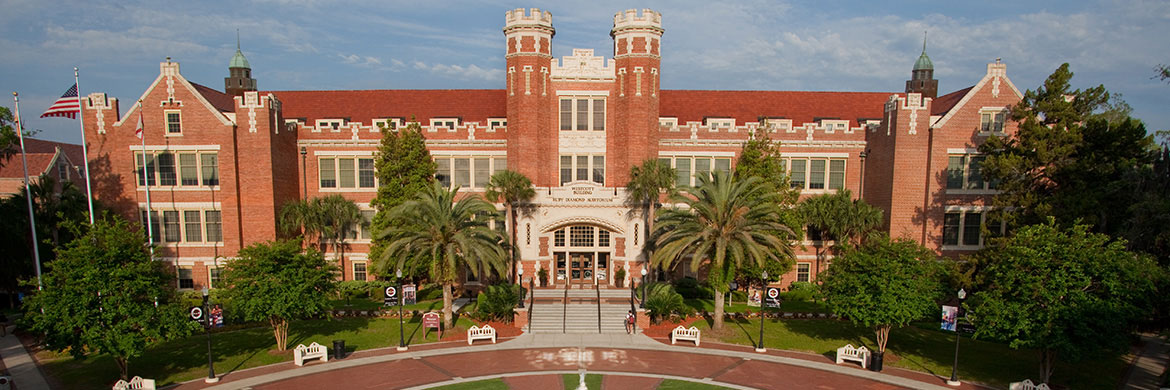
FSU’s Tallahassee-area campuses include over 400 buildings and cover over 1,600 acres.[1] The bulk of these facilities are located on the main campus (Leon County Campus), near downtown Tallahassee. Other locations include the Rez Lakefront Park, the Florida A&M University-Florida State University College of Engineering facility and the National High Magnetic Field Laboratory.
FSU is an institution of 44,308 students, including 34,849 Florida residents. 42,507 of those students attend class on the Leon County campus.[2] The university’s total operating budget for 2023-2024 academic year was approximately $2.1 billion[3], and the budget for 2024-2025 was approximately $3 billion.[4]
In 2024, FSU employed 16,069 people across all departments. 7,414 of them were regular-salaried, full-time employees. An additional 103 persons were employed on a regular-salary part-time classification, and the remaining 8,552 were employed under OPS classification.[5]
In 2024, Tallahassee City Commissioners adopted an $868.4 million operating budget for the 2025 fiscal year. This is approximately $42 million more than the FY24 operating budget.[6] FSU’s operating budget for FY24 was $2.1 billion[7], more than double that of the City of Tallahassee.
University operating revenues totaled $906 million for the 2023-2024 FY, a $18 million increase from 2022-2023. Operating expenses totaled $1.85 billion for the 2023-2024 FY, up $219 million from 2022-2023. Net non-operating revenues totaled $1.09 billion for the 2023-2024 FY, an increase of $202 million from the 2022-2023 FY.[8]
The average bi-weekly payroll for all FSU system employees was $42,267,691 and the total payroll for fiscal year 2024 (including gross salaries and employer paid benefits and taxes) was $1,098,595,953.[9]
Faculty, Staff, and Alumni
University faculty and staff contribute to their local economy through their purchasing power and taxes. In 2024, the average monthly rent payment in Tallahassee was $1,718. Full-time salaried employee, faculty and staff contributions were estimated to be $12,727,252 per month or $152,847,024 annually.[10] These contributions do not account for part-time OPS employees.
It is estimated that the average resident of Leon County, with a population of 300,448, paid $1,218 in sales taxes to the county (in 2024).[11] The 2,760 traditional faculty members are estimated to have contributed $3,361,680 in sales taxes to Leon County in 2024.[12] All 7,414 full-time salaried employees contributed $9,030,252 in sales tax in 2024.[13]
Every year since 2000, at least one FSU faculty member has been awarded a Fulbright scholarship. Six FSU faculty members and one postdoctoral researcher were endowed as Fulbright Scholars for the 2024-25 school year.[14]
As of April 2025, some 257,000 of approximately 420,000[15] living FSU alumni lived and worked in Florida, with 46,417 in Leon County. This concentration of FSU alumni was higher than anywhere in the state.[16]
Research
Total Research Expenditures (external only) were $290.1million for the 2024 fiscal year, a $30.5 million increase from the previous fiscal year.[17]
The total amount of Sponsored Research Contract and Grants (C&G) awards received during FY 2024 was $415.7 million, a $113.7 million increase from the previous fiscal year. $241.1 million of these contracts and grants were from the federal government, $52.2 million from the state and local government and $122.3 million privately funded.[18]
FSU researchers received $271 million in funding for fiscal year 2025, $145 million less than 2024. Funds came from federal, state, and private sources.[19]
FSU and FSU Research Foundation since 2005-06 has supported a series of programs to support translational research funding to move technologies closer to the market including: a historic GAP fund at $250,000 per year from 2006 to 2003FY, over $1M in total funding awarded between 2024 through 2026 through an National Science Foundation funded Seed Translational Research Project grants to support projects with ~a year timeline towards translational milestone, and $100,000 each fiscal year in prizes to advance Florida State University Startups through the Discovery Challenge companion since 2023.
Students
FSU students spend substantially in the area. Students spend money on tuition, books, school supplies, housing, food, transportation, clothing, and entertainment. These expenditures vary by the residency status and degree level of each student. Student spending by Florida State University students, both in funds spent in the area and in funds spent at the university, totaled $1.044 billion in fiscal year 2024.[20]
Costs for students attending Florida State University depend on each student’s living situation and residency status. Florida residents living on campus or in an offcampus apartment paid an estimated $25,398 during the 2024-2025 academic year, while Florida residents living with their parents paid $20,162. This includes tuition, housing, books, transportation, and other personal expenses. Non-Florida residents living on campus or in an off-campus apartment paid an estimated $39,831 during the 2024-2025 academic year, and non-residents living with their parents paid $33,951.[21]
44,308 FSU students are estimated to have contributed $53.96 million in sales taxes to Leon County in 2024. This accounts for about 16% of total estimated sales tax revenue to Leon County in 2024.[22],[23]
Capital Expenditures
In FY 2024-2025, FSU has $519 million dedicated to capital projects.[24] These projects are funded through the FSU budget, bondholders, FCO grants, PECO allocations, departmental funding, ESCO budget allocations and private donations.
FSU receives funding for capital expansion projects through the State of Florida’s Public Education Capital Outlay (PECO). For fiscal year 2024-2025, FSU received $3,676,227 in PECO appropriations for developmental research.[25]
FSU is Tallahassee’s top user of electricity, using 6.81%. The state of Florida placed second, using 3.54%. In third, the City of Tallahassee used 3.51%. In 2024, the university used more electricity than Florida A&M University (1.47%), Leon County government (0.92%), and Tallahassee Memorial HealthCare (1.59%) combined.[26]
Visitors to FSU
By the end of FY 2024, the economic impact of tourism on Leon County is expected to be over $1.3 billion. Based on estimates of the number of total visitors to Leon County in FY 2024, each visitor to Leon County on average will generate $522 to the local economy during their visit.[27]
Football-game weekends bring in a significant amount of tourism to Leon County. Out-of-town attendees typically total $137.46 million in direct spending during FSU’s six home games.[28]
FSU home games hosted an average of 53,479 attendees per game for 2024[29], with a season-high attendance of 51,107 for the University of Florida game.[30] In the Fall 2024 season, FSU football attracted 129,022 out-of-town visitors to Leon County.[31]
In addition to football, FSU varsity sports such as baseball, softball, volleyball, soccer and golf bring participants and visitors who contribute to the local economy. Visiting baseball teams booked an average of 105 room nights per weekend. FSU hosted 34 home baseball games in 2024.[32] FSU also hosted 15 home volleyball games in which participants booked an average of 14 room nights per weekend. In total, baseball and volleyball generate an additional $368,368 in direct impact through participant lodging in Tallahassee.[33]
Visitors also booked 161,228 nights and spent $22,118,918 on lodging. On average, out-of-town attendees to football games spent $87.38 per day and $349.50 per trip.[34] In a typical season, football home games result in $106.5 million of economic impact on Leon County.[35]
Opening Nights at FSU performances and educational events attracted over 15,000 attendees during the 2023-2024 season.[36]
Camps
In the summer of 2025, 890 campers attended camps at the Challenger Learning Center of Tallahassee.[37]
In the 2023-2024 academic year, FSU athletic camps had over 8,500 attendees: 3,310 in football, 1,551 in men’s basketball, 900 in softball, 800 in volleyball, 218 in soccer, 550 in baseball, 600 in women’s basketball, 292 in cross-country/track, 137 in swimming, 40 in beach volleyball, 75 in men’s tennis, and 82 in men’s and women’s golf.[38]
There are over 20 academic and civics camps in session throughout the university every year, and thousands of school students attend.
The College of Arts & Sciences’ Office of STEM Teaching Activities recorded 51,229 total attendees across its programs in the 2025-2025 academic year, including 12,270 Florida K-12 students and teachers.[39]
11 different music camps are offered every summer at FSU. In 2025, FSU Music Camps’ face-to-face enrollment was over 1,600 students. During the summer of 2020, camps provided 41 free virtual classes to over 5,000 students. More than 65% of the eligible students who have attended the camps eventually enroll at FSU in majors across the university.[40]
FSU Foundation & Volunteer Work
Total expenses of the FSU Foundation increased 53% ($32.7 million) from 2023 to 2024.[41]
For the fiscal year ending June 30, 2024, the FSU Foundation allocated $94,027,686 in total gift commitments. Total gifts included $27,422,981 in pledges, $3,368,114 gifts-in-kind, $39,893,343 in deferred gifts and $23,343,248 in cash and securities.[42]
Total university endowments totaled $1,029,931,070, an increase of $82,922,309 from FY2022-2023; FSU Foundation endowments were $795,926,890, an increase of $72,998,999 from FY2022-2023.[43]
These commitments were given by a total of 20,089 donors. 51% were alumni/attendees, 8% current students, 11% parents and 18% friends of the university. The remaining donors were a conglomerate of faculty, staff, corporations and partner foundations.[44]
In FY 2023-2024, The gift commitments from the FSU Foundation were allocated to various departments at the university. $19,783,083 was allocated for student financial aid, $6,038,857 to the faculty and staff, $3,432,017 for public service, $1,539,705 for property and infrastructure, $21,557,485 for the academic divisions, $507,860 toward research, $165,790 toward Strozier Library and $40,831,642 for other restricted purposes. The remaining funds were allocated for other unrestricted purposes, such as physical plants and loans.[45] FSU received a $100 million gift in 2015 from Jan Moran and the Jim Moran Foundation to create the Jim Moran School of Entrepreneurship, which later became a college. In 2016, Brian and Kathryn Ballard gifted real estate to the university to serve as the headquarters for the institute.[46]
For the 2024-2025 academic year, 4,220 FSU students reported a total of 214,258 hours of volunteer work through the FSU ServScript Program. Using the value of a volunteer hour as determined by independentsector.org, this contribution of service hours saved local communities, governments and nonprofit organizations approximately 7.4 million dollars.[47],[48]
Economic Impact
FSU generated $2.1 billion of direct revenue or expense for within Florida. Including indirect effects, FSU contributed $3.95 (or $4) billion worth of total industry output (revenue/sales) and 36,034 jobs.[49]
Including indirect effects, economic activity generated by FSU in fiscal year 2024 supported $1.94 billion in labor income, $675 million in property income and $70 million in business taxes.[50]
In 2023, the present value of lifetime earnings of an FSU graduate with a bachelor’s degree was expected to be $650,709. more than a high school graduate.[51]
[28] Downs and St. Germain Research 2021, Florida State Football: Estimated Economic Impact on Leon County. Note that these numbers are pre-COVID-19 pandemic.
[47] Maria Paula McIntyre Program Coordinator for leadership & Service; personal communication. Note that much of the volunteer work performed by FSU students is not reported to ServScript, so the impact of volunteer work is likely much greater.